


http://m.youtube.com/#/watch?v=gJ0uojUHYdA&desktop_uri=%2Fwatch%3Fv%3DgJ0uojUHYdA&gl=GB
Friday, 8 February 2013
Long time no post!
I haven't written anything here for ages but just came across some pictures and this video clip which may well be of interest so thought I'd post them for you. Sadly some of the links I have previously posted have broken. If I manage to find them I'll post them up.
http://m.youtube.com/#/watch?v=gJ0uojUHYdA&desktop_uri=%2Fwatch%3Fv%3DgJ0uojUHYdA&gl=GB


http://m.youtube.com/#/watch?v=gJ0uojUHYdA&desktop_uri=%2Fwatch%3Fv%3DgJ0uojUHYdA&gl=GB

Thursday, 1 July 2010
Traditional Boots
wow! I think I have previously mentioned Valenki, traditional East European felt boots,
this web site has been passed on it shows the valenki production process and is well worth a look
www.muse.lt/keliones/kaip-gimsta-veltiniai-foto-reportaas
this web site has been passed on it shows the valenki production process and is well worth a look
www.muse.lt/keliones/kaip-gimsta-veltiniai-foto-reportaas
Friday, 11 June 2010


Monday, 7 June 2010
2010 in general and Wool Weekend 5/6th June
This summer I won't be feltmaking at the Kentwell Hall reenactment. I'll be working in the house making subtleties for "The Family". So I guess there won't be many, if any posts for this blog this year.
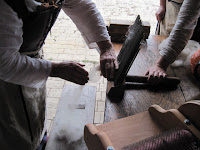
Last weekend I was, however at Wool Weekend with the Regional International Feltmakers Association group and the Lavenham Guild of Weavers, Spinners and Dyers. Alison, a Guild member, kindly brought along her wool combs, Widow Meg showed us how to use them and Alison donated them to Kentwell. When you see what they are like you will know why they are in safe keeping rather than lying around.
Last weekend I was, however at Wool Weekend with the Regional International Feltmakers Association group and the Lavenham Guild of Weavers, Spinners and Dyers. Alison, a Guild member, kindly brought along her wool combs, Widow Meg showed us how to use them and Alison donated them to Kentwell. When you see what they are like you will know why they are in safe keeping rather than lying around.
Sunday, 25 April 2010
Carders
Further to my last posting "Lucy the Tudor" has kindly given me more information about the use if carders. Its a nuisance that I can't directly cut and paste directly into the blog so, if the following links don't work, its because I haven't typed them out correctly, let me know.
Here are some links which evidence the existance and use of hand carders. This is in addition to wool combs/ hackles and possibly other methods. I am keen to know what and how they are doing in the last painting!
Anyway here goes;
http://www.imagesonline.bl.uk/results.asp?image=071982
http://nuernberger-hausbuecher.de/75-Amb-2-279-16-v
http://museumoflondon.org.uk/English/EventsExhibitions/Permenent/med
http://www.themorgan.org/collections/collections.asp?id=108
In addition Lucy tell me that there are lots of images of long spikey wool combs and defends slow and careful carding rather than her own hasty and impatient (much less effective carding).
I've posted a link to your website as a thank you to Lucy - have a look - she makes and sells some lovely things for reenctors.
Here are some links which evidence the existance and use of hand carders. This is in addition to wool combs/ hackles and possibly other methods. I am keen to know what and how they are doing in the last painting!
Anyway here goes;
http://www.imagesonline.bl.uk/results.asp?image=071982
http://nuernberger-hausbuecher.de/75-Amb-2-279-16-v
http://museumoflondon.org.uk/English/EventsExhibitions/Permenent/med
http://www.themorgan.org/collections/collections.asp?id=108
In addition Lucy tell me that there are lots of images of long spikey wool combs and defends slow and careful carding rather than her own hasty and impatient (much less effective carding).
I've posted a link to your website as a thank you to Lucy - have a look - she makes and sells some lovely things for reenctors.
Thursday, 22 April 2010
Hackles
Having been given a roasting by a lady whose "hackles" were up after visiting Kentwell to find a gaggle of girls half heartedy using modern carders to prepare wool. She was adament that these carders would not have been available (feel free to tell me differently) but that wool would have been prepared using "hackles". I followed her lead to find out more about hackles and how to use them. If you want to do the same, do a search on u-tube there are various videos of people using a variety of different hackles and wool combs (which look similar to hackles - just a bit smaller).
In the course of all this I came across a one video which I beleive may give an amazing insight into how wool might have been prepared and used in tudor times. Its called "what people do with wool in a rural part of Serbia" - do have a look, its amazing. They use their fingers and/ or hackles to prepare the wool; they spin in a variety of different ways; they appear to put a woollen garment into a fire; the immerse garments in water and beat them with a paddle. The paddle is just like those shown in a picture of washerwomen in tudor times (which I now cannot find). Do have a look at this video, once you get through the evocative music at the beginning it is absolutely fascinating.
OK not wool but wiki describes the use of hackles with flax; "in this process the fibre is pulled through various different sized hackles. A hackle is a bed on nails, sharp; long; polished steel pins drivne into wooden blocks at regular spacing. A good progression is from 12 pins per square inch; to 12; to 25; to 48; to 80. The first three will remove the straw and the last two will split and polish the fibres. Someof the finer stuff that comes off the last hackles can be carded like wool."
I'd love to find out more - can you contribute any information?
In the course of all this I came across a one video which I beleive may give an amazing insight into how wool might have been prepared and used in tudor times. Its called "what people do with wool in a rural part of Serbia" - do have a look, its amazing. They use their fingers and/ or hackles to prepare the wool; they spin in a variety of different ways; they appear to put a woollen garment into a fire; the immerse garments in water and beat them with a paddle. The paddle is just like those shown in a picture of washerwomen in tudor times (which I now cannot find). Do have a look at this video, once you get through the evocative music at the beginning it is absolutely fascinating.
OK not wool but wiki describes the use of hackles with flax; "in this process the fibre is pulled through various different sized hackles. A hackle is a bed on nails, sharp; long; polished steel pins drivne into wooden blocks at regular spacing. A good progression is from 12 pins per square inch; to 12; to 25; to 48; to 80. The first three will remove the straw and the last two will split and polish the fibres. Someof the finer stuff that comes off the last hackles can be carded like wool."
I'd love to find out more - can you contribute any information?
Friday, 16 April 2010
Ryland Fleece - follow up
Well, I spent most of monday optimistically carding a whole ryland fleece. I tried to felt it today and was very fed up. Although lovely and soft I don't think Ryland is a wool for felting. It barely hung together. It is probably lovely to spin and knit which is, after all, what was said in the reference refered to beforehand.
Thursday, 25 March 2010
Ancient China
This is incredible- delving back further into history there has been an amazing archeological find in China which indicates that there were caucasian peoples on their western boundaries around 3,000 years ago. Mummified bodies with wonderfully preserved textiles have been found. Some of the textiles have been made of felt.
If you would like to find out more about these finds have a look at these links
www.utube.com/watch?v=TkOcuzDCX-Uandfeature=related
www.utube.com/watch?v=pDMkWPAJ_YOandfeature=channel
If you would like to find out more about these finds have a look at these links
www.utube.com/watch?v=TkOcuzDCX-Uandfeature=related
www.utube.com/watch?v=pDMkWPAJ_YOandfeature=channel
Thursday, 18 March 2010
Ryland Sheep
in "wooly wonderings" post published on 9th September 2008 I mentioned a reference to Ryland sheep wool in relation to Monmouth Caps. Since then I have periodically searched ebay to try and get hold of some of this fleece but to no avail. then guess what happened this evening? I was put in touch with a lady who offered me fleece from Shetland, North Ronaldsay and ... Ryland sheep.. how exciting - I can hardly wait!
to read more about Ryland Sheep have a look at www.freespace.virgin.net/a.wood/index2.html
to read more about Ryland Sheep have a look at www.freespace.virgin.net/a.wood/index2.html
heads and hats
found a new web site today www.thehatsite.com
it has all sorts of useful information - did you know for instance that
it has all sorts of useful information - did you know for instance that
- head shapes and sizes vary from country to country. In general the smallest, roundest heads are found in the far east. Western heads tend to be more oval in shape and the largest heads are, apparantly, found in Germany.
- hat sizes are measured by the circumference of the head just above the ears.
- You are not likely to find an adult head bigger that 64cm or smaller than 51cm circumference.
Monday, 15 March 2010
communication
I came across the following web sites when searching for ways to enhance the way I speak to people when I am in the 16th Century
This site has an amzing list of proverbs - I couldn't believe how many are still in circulation
http://www.famous-proverbs.com/
A man called Ron Bailey has put the entire Tynedale Bible 1525 on line - what a labour of love that must have been. It gives a great insight into use of language at the time
www.wesley.nnu.edu/biblical_studies/tynedale
for ideas about day to day greetings and conversation
www.home.wwdb.org/atkinsonk/public_html/Basic_Faire_Speech.html
This site has an amzing list of proverbs - I couldn't believe how many are still in circulation
http://www.famous-proverbs.com/
A man called Ron Bailey has put the entire Tynedale Bible 1525 on line - what a labour of love that must have been. It gives a great insight into use of language at the time
www.wesley.nnu.edu/biblical_studies/tynedale
for ideas about day to day greetings and conversation
www.home.wwdb.org/atkinsonk/public_html/Basic_Faire_Speech.html
Monday, 7 December 2009
sorry I haven't written anything for absolutely ages, got a bit put off by the soap making which I have now given up as a bad job. It was so distracting. Hopefully I'll get going again next year.
Happy Christmas and a welty, helty and felty 2010!
Good wife Joan
I have just deleted all the unsuccessful soap making posts - am so disappointed it dodn't work out despite all that trying.
Happy Christmas and a welty, helty and felty 2010!
Good wife Joan
I have just deleted all the unsuccessful soap making posts - am so disappointed it dodn't work out despite all that trying.
Tuesday, 30 December 2008
16th Century Hat shapes - web search results
While watching nonsense on TV I decided to have a look for early 16th century hat shapes and came across the following links which you might also find of interest;
- a selection of portraits can be found on the National Portrait Gallery UK web site http://www.npg.org.uk/live/search/portList.asp?search=ap&subj=90%3BHats+and+head-attire&page=2
- Dawn provides a selection of flat caps, she suggests that they are sewn but I think some of the hats pictured, especially those with the turned up brims, definately could and probably would, have been made from felt. The brims would stay up better. http://www.reddawn.net/costume/hats.htm
- although this hat looks like it was sewn, possibly out of leather? http://www.npg.org.uk/live/search/portrait.asp?search=ap&subj=90%3BHats+and+head%2Dattire&rNo=13
- wikepedia also has some interesting info and pictures - here is some general fashion information with sections on head gear for women and men http://en.wikipedia.org/wiki/1500-1550_in_fashion#Hairstyles_and_headgear and here is a close up portrait showing a barett (looks like a felted beret to me) http://en.wikipedia.org/wiki/File:Hans_Baldung_021.jpg

let me know if you find anything else!
Thursday, 18 December 2008
More on Monmouth (see post on 7th Sept 2008)
been a bit out of sorts of late so
not a lot of blogging (or much else
for that matter) but was mightily
cheered by Melody who, after
reading my plea for a knitter,
has knitted then felted a
monmouth cap, and Jon,
who is sporting the hat in the
photo's and agreed to them
being published here.
Even better Melody has offered
to knit one/some more for us to
have as props to work on next
year! Oh yes, for those of you who
don't already know, next year is
1535 - a big fashion change is on
the cards!
Thank you Melody and Jon (doesn't he look handsome!)
not a lot of blogging (or much else

for that matter) but was mightily
cheered by Melody who, after
reading my plea for a knitter,
has knitted then felted a
monmouth cap, and Jon,
who is sporting the hat in the
photo's and agreed to them
being published here.
Even better Melody has offered
to knit one/some more for us to

have as props to work on next
year! Oh yes, for those of you who
don't already know, next year is
1535 - a big fashion change is on
the cards!
Thank you Melody and Jon (doesn't he look handsome!)
Thursday, 18 September 2008
Beavers
Beavers were nearly hunted to extinction in Europe during the 16th century for their wool which was used in the manufacture of fine hats. Once the Americas were found, beaver skin was so prized that it was imported for the felt hat industry. Especially prized were beaver skins which had been worn, either by native American Indians or by early settlers, as it was found that once worn the fur itself would felt more easily. Those of us who were brought up with cowboy films probably all have an image of Billy Crockett and his beaver hat with the strange tail hanging down the back!
Here is a translation of what Plinius Secundus had to say about beavers in his book "The Historie of the World. Book VIII" written in 1601 http://penelope.uchicago.edu/holland/pliny8.html#b11
"The Bievers in Pontus gueld themselves, when they see how neere they are driven, and bee in danger of the hunters: as knowing full well, that chased they bee for their genetoires: and these their stones, Physicians call Castoreum. And otherwise, this is a daungerous and terrible beast with his teeth. For verily, hee will bite downe the trees growing by the river sides, as if they were cut with an axe. Looke where he catcheth hold of a man once, he never leaveth nor letteth loose untill hee have knapped the bones in sunder, and heard it cracke againe. Tailed hee is like a fish, otherwise he resembleth the otter. Both those beasts live in the water altogether, and carrie an haire softer than any plume or downe of feathers."
Master Pinchbeck can remember working with Beiver at his fathers workshop in London!
It looks like Beaver were also hunted for their genitals and they would bite them off rather than let the hunter have them! I like Pliny's description of the beast and how strong and ferocious it was deemed to be. They are a great talking point - even though the likely hood of actually getting hold of a beaver skin these days, let alone using it for felting is very slim!
p.s. just checked out "castoreum" and it seems that these are glands used in perfumery and for various remedies, the wearer will be irresistible!
Here is a translation of what Plinius Secundus had to say about beavers in his book "The Historie of the World. Book VIII" written in 1601 http://penelope.uchicago.edu/holland/pliny8.html#b11
"The Bievers in Pontus gueld themselves, when they see how neere they are driven, and bee in danger of the hunters: as knowing full well, that chased they bee for their genetoires: and these their stones, Physicians call Castoreum. And otherwise, this is a daungerous and terrible beast with his teeth. For verily, hee will bite downe the trees growing by the river sides, as if they were cut with an axe. Looke where he catcheth hold of a man once, he never leaveth nor letteth loose untill hee have knapped the bones in sunder, and heard it cracke againe. Tailed hee is like a fish, otherwise he resembleth the otter. Both those beasts live in the water altogether, and carrie an haire softer than any plume or downe of feathers."
Master Pinchbeck can remember working with Beiver at his fathers workshop in London!
It looks like Beaver were also hunted for their genitals and they would bite them off rather than let the hunter have them! I like Pliny's description of the beast and how strong and ferocious it was deemed to be. They are a great talking point - even though the likely hood of actually getting hold of a beaver skin these days, let alone using it for felting is very slim!
p.s. just checked out "castoreum" and it seems that these are glands used in perfumery and for various remedies, the wearer will be irresistible!
Tuesday, 9 September 2008
woolly wonderings
One of the things which has exercised my mind since setting up felting at Kentwell Hall has been that of wool.
The first year (2006) we just had the wool from the Norfolk Horn sheep that live on the Manor. We found this wool was difficult to work with which set me to wondering why it didn't felt easily; if we could make it easier; and what wool actually would have been used in earlier times.
The Norfolk Horn is a predecessor of the Black faced Suffolk Sheep, I have now found out that felters today generally consider working with this wool to be a wasted energy. With perseverence we have got it to felt albeit the results are springy and prone to pilling. However all things have their purpose and this has given great comfort to a number of feet (insoles) and backsides (seat pads). I also experimented and found that it was more suited to needle felting - not a lot of good for Tudor times but a handy 'mend it' option for when visitors have gone home!
The best sheep wool for felting has the right thickness, the right crimp and the right staple (I think I will do a seperate post about this another time).
Turning my thoughts to how can we make this easier I wondered about water; soap; and the wool.
With experimentation we found that the hotter the water the better - that was some progress.
Would it make a difference if the soap we used we more akin to that used in Tudor times? we made our own soap but found that although its a great talking point, it didn't make a lot of difference to the felting, its just very rough on our hands.
Was soap even used to create the right enviroment to get the wool to felt? don't know about that one yet!
I have heard of carrotting for other felting fibre (rabbit, beaver), is there anything that could be done to make this wool easier to work with. Recently I found mention of felters using short staple wool and felters choping wool to shorter lengths. We have yet to give this serious try.
These days felters seem to favour Merino wool imported from Australia, I didn't think we would be importing wool from Australia in the 16th century so that option seemed to be out and I have been trying to identify other options. There has been mention of 'Estridge Wool'; 'Wool from Pollonia'; 'Spanish Felt Wool' in the OED on line (see 'F' words) and in the information about Monmouth caps there is reference to 'Ryedale Wool'. This year "one who knows much of such things" did say to me that much wool was imported from the Baltic areas? What other sheep would there have been around at the time?
In my modern life I was introduced to Blue Faced Leicester which felts beautifully in no time at all. I don't know if this wool would have been around at the time but we bought some, a beautiful soft brown colour and all ready prepared to use this summer - we had our most successful hat making outcomes yet. I am really proud of the hat I made, I will try and post a picture soon!
Since the summer I have been exploring options from the Baltic and was kindly sent samples of Finnwool and wool from the Gotland sheep by Rod Finland (http://www.rod.4felts.com/ just have a look at his web site for inspirational modern felting!). I have made some small samples and am most impressed with the results. I need to experiment with these a bit further.
I have recently found out that the modern Merino Sheep are descended from Spanish Sheep and am guessing that these were the sheep which provided the fine 'Spanish Felt Wool'. Maybe we can legitimately use Merino after all!
Next I want to try and get hold of the fleece of a Ryedale sheep and find out exactly what is Estridge Wool? - any ideas?
The first year (2006) we just had the wool from the Norfolk Horn sheep that live on the Manor. We found this wool was difficult to work with which set me to wondering why it didn't felt easily; if we could make it easier; and what wool actually would have been used in earlier times.
The Norfolk Horn is a predecessor of the Black faced Suffolk Sheep, I have now found out that felters today generally consider working with this wool to be a wasted energy. With perseverence we have got it to felt albeit the results are springy and prone to pilling. However all things have their purpose and this has given great comfort to a number of feet (insoles) and backsides (seat pads). I also experimented and found that it was more suited to needle felting - not a lot of good for Tudor times but a handy 'mend it' option for when visitors have gone home!
The best sheep wool for felting has the right thickness, the right crimp and the right staple (I think I will do a seperate post about this another time).
Turning my thoughts to how can we make this easier I wondered about water; soap; and the wool.
With experimentation we found that the hotter the water the better - that was some progress.
Would it make a difference if the soap we used we more akin to that used in Tudor times? we made our own soap but found that although its a great talking point, it didn't make a lot of difference to the felting, its just very rough on our hands.
Was soap even used to create the right enviroment to get the wool to felt? don't know about that one yet!
I have heard of carrotting for other felting fibre (rabbit, beaver), is there anything that could be done to make this wool easier to work with. Recently I found mention of felters using short staple wool and felters choping wool to shorter lengths. We have yet to give this serious try.
These days felters seem to favour Merino wool imported from Australia, I didn't think we would be importing wool from Australia in the 16th century so that option seemed to be out and I have been trying to identify other options. There has been mention of 'Estridge Wool'; 'Wool from Pollonia'; 'Spanish Felt Wool' in the OED on line (see 'F' words) and in the information about Monmouth caps there is reference to 'Ryedale Wool'. This year "one who knows much of such things" did say to me that much wool was imported from the Baltic areas? What other sheep would there have been around at the time?
In my modern life I was introduced to Blue Faced Leicester which felts beautifully in no time at all. I don't know if this wool would have been around at the time but we bought some, a beautiful soft brown colour and all ready prepared to use this summer - we had our most successful hat making outcomes yet. I am really proud of the hat I made, I will try and post a picture soon!
Since the summer I have been exploring options from the Baltic and was kindly sent samples of Finnwool and wool from the Gotland sheep by Rod Finland (http://www.rod.4felts.com/ just have a look at his web site for inspirational modern felting!). I have made some small samples and am most impressed with the results. I need to experiment with these a bit further.
I have recently found out that the modern Merino Sheep are descended from Spanish Sheep and am guessing that these were the sheep which provided the fine 'Spanish Felt Wool'. Maybe we can legitimately use Merino after all!
Next I want to try and get hold of the fleece of a Ryedale sheep and find out exactly what is Estridge Wool? - any ideas?
Sunday, 7 September 2008
Monmouth Cap
(a knitted and fulled, brown hat with a 'button' on top).
Now knitting has never been my strong point, in fact I would go as far as to say that I really do not like knitting. However it is clear that knitting was a skill practised in Tudor times and that one of the popular hats was in fact knitted and then fulled to make a durable, warm and water replellent head covering.
Knowing that from 1488 to 1597 legistation existed to protect the knitted cap industry and that people were knitting what became known as 'Monmouth caps' as early as the mid 15th century, the last time we went camping in Wales we visited the museum in Monmouth (and a very splendid castle) where we saw a real Monmouth Cap on display.
My subsequent investigations unearthed a web site which give a history and knitting instructions for the cap. It seems pointless for me to repeat any of what the author, Jennifer Carlson, has said so you may as well have a look for yourself
http://www.personal.utulsa.edu/~Marc-Carlson/jennifer/Monmouth.htm
I would really love it if someone wanted to knit one or two of these hats for us to full and have on display at Kentwell - I don't mind buying the wool - hint hint!
Now knitting has never been my strong point, in fact I would go as far as to say that I really do not like knitting. However it is clear that knitting was a skill practised in Tudor times and that one of the popular hats was in fact knitted and then fulled to make a durable, warm and water replellent head covering.
Knowing that from 1488 to 1597 legistation existed to protect the knitted cap industry and that people were knitting what became known as 'Monmouth caps' as early as the mid 15th century, the last time we went camping in Wales we visited the museum in Monmouth (and a very splendid castle) where we saw a real Monmouth Cap on display.
My subsequent investigations unearthed a web site which give a history and knitting instructions for the cap. It seems pointless for me to repeat any of what the author, Jennifer Carlson, has said so you may as well have a look for yourself
http://www.personal.utulsa.edu/~Marc-Carlson/jennifer/Monmouth.htm
I would really love it if someone wanted to knit one or two of these hats for us to full and have on display at Kentwell - I don't mind buying the wool - hint hint!
Thursday, 4 September 2008
how to do everything!
found a great book when I was googling last night
"The Circle of the Mechanical Arts" written by Thomas Martin in 1813
there is a whole chapter on hat-making and chapters on just about everthing else you could possibly think of making. OK so its not Tudor how to do everything but its a lot older than most craft books you can find and has some great insights into much earleir methods of production than we would use these days and ... there is a great description of bow carding (you will already know that this is something that has been interesting me this year).
Its been scanned into the google on-line library so you can find it and download it for yourself if you google the name of the book.
"The Circle of the Mechanical Arts" written by Thomas Martin in 1813
there is a whole chapter on hat-making and chapters on just about everthing else you could possibly think of making. OK so its not Tudor how to do everything but its a lot older than most craft books you can find and has some great insights into much earleir methods of production than we would use these days and ... there is a great description of bow carding (you will already know that this is something that has been interesting me this year).
Its been scanned into the google on-line library so you can find it and download it for yourself if you google the name of the book.
Tuesday, 2 September 2008
Deliberately Concealed Garment
During the reformation someone went to the trouble of hiding a blue wool-felted hat made around 1350 in a cavity in a church in Little Sampford Church, Essex, UK. It was conserved in 1979 and is now displayed in a museum in Saffron Walden, Essex.
When I saw a picture of it I could hardly beleive how modern it looked with a rounded crown and flat brim all made in one piece. You too can see a picture and read more about it at http://search.concealedgarments.org/results.jsp?view=details&pos=2&id=1553
thanks to Karen Larsdatter for pointing me in this direction.
When I saw a picture of it I could hardly beleive how modern it looked with a rounded crown and flat brim all made in one piece. You too can see a picture and read more about it at http://search.concealedgarments.org/results.jsp?view=details&pos=2&id=1553
thanks to Karen Larsdatter for pointing me in this direction.
Sunday, 31 August 2008
'F' words
Feather band
A sort of HATBAND, presumably one designed to hold decorative FEATHERs, and fashionable in the seventeenth century as shown, for example, in the picture of the Gunpowder Plot Conspirators painted in 1605 by an unknown artist, and that of the Squire of Alsatia painted in1688 by Laroon [Cumming (1984, reprint 1987)]. The one example found in the Dictionary Archive is dated the same year as the Gunpowder Plot [Inventories (1605)].
Not found in the OED
Sources: Inventories (early). References: Cumming (1984, reprinted 1987).
Felt [ffelt; felte]
A TEXTILE made from WOOL or mixed fibres compressed, rolled or fulled to bind them together. Either FELT WOOL, of which there were many types, was used, or the fur from the BEAVER SKIN, CONY SKIN or RABBIT SKIN.
Felt was used mainly to make FELT HATs, and by association the term indicated both hats made of felt and, on occasion, hats in general. Many of the terms that might be expected as descriptors for felt hat are found in association with felts. Some of these denote the WOOL from which the hat was made, hence 'estridge womens felts' made from ESTRIDGE WOOL [Inventories (1604)], 'Spanish or Portingale felts' made from SPANISH FELT WOOL [Rates (1582)], or 'pollonian feltes' made of POLONIA WOOL [Inventories (1604)].
OED earliest date of use c1000 as a fabric; c1450 as a hat
Found described as with BANDs, without bands, brayed, COARSE, COLOURED, DUTCH, DYED, FINE, FRENCH, NEW, pollonian, PORTUGAL, SMALL, SPANISH, lined with TAFFETA, undyed, unlined, untrimmed, lined with VELVET, WHITE, WOOL Found made in sizes or styles suitable for BOY, CHILDREN, GIRL, MEN, WOMEN, YOUTHFound in units of DOZEN Found rated by the DOZEN
See also FELT WOOL, HAT, RABBIT FUR. Sources: Acts, Diaries, Houghton, Inventories (early), Inventories (mid-period), Inventories (late), Patents, Tradecards.
Felt cloak [felt cloke; cloakes of felt]
In the late-sixteenth century and the early seventeenth, CLOAKs made of FELT became fashionable. Both the cloaks themselves and pieces of felt of the appropriate size were apparently imported from FRANCE, where the making of FELT HATs had first been established. The entry in the Book of Rates of 1660 went into some detail, describing such felt pieces as 'for Cloaks, French-making, three yards and an half long, one yard and an half broad the felt' [Rates (1660)].
OED online earliest date of use: 1599
Found in units of PIECESources: Rates.
Felt hat [ffelt hatt; felte hatte; felte hatt; felte hat; felt or wool stuff or beaver hat; felt or beaver stuff hats; felt hatt]
The term was often abbreviated to FELT. HATs made of FELT seem to have been developed as a manufacture in Normandy in the mid-fifteenth century from whence they were introduced into London. Their manufacture spread rapidly throughout England with an important centre just north of Bristol. Making felt hats required special short-fibred carding wool, sometimes called FELT WOOL. Much of this was imported from Spain and Portugal (SPANISH FELT WOOL), and later from Austria (ESTRIDGE WOOL) and Poland (POLONIA WOOL). Their manufacture involved several processes: carding, basining, felting, dressing, pouncing or pounding, blocking and dyeing. By 1609 the BEAVER HAT or CASTOR had been introduced using BEAVER WOOL. Towards the end of the seventeenth century, the Huguenots of Wandsworth (SW London) introduced yet another type called the Caudebac hat after the place they came from near Rouen. These hats were made of a fine, waterproof felt using a mixture of fine vicuna wool and rabbit wool [Kerridge (1985)]. Often all types were lumped together regardless of origin as 'Felt or Wool, Stuff or Beaver Hats' [Acts (1784)].
Once the basic shape had been made, a felt hat could be LINED with fashionable SILK fabrics like SARSENET, TAFFETA or VELVET [Inventories (1598)], or left UNLINED, and decorated with a HATBAND.
OED earliest date of use: 1457
Found described by NEWFound in units of DOZEN, PIECE
Sources: Acts, Inventories (early), Newspapers, Patents. References: Kerridge (1985).
Felt wool
A type of short-staple WOOL, often imported, for making FELT, particularly for HATs, felt wool is not to be confused with WOOL FELL, which was often known as 'Fell wool'. Topsell (1607), cited by the OED, gave it as an alternative name for Feltriolana, which would seem to be a term with much the same meaning. Felt wools were imported from Spain and Portugal, hence SPANISH FELT WOOL, and later from Austria as ESTRIDGE WOOL and from POLAND as POLONIA WOOL [Kerridge (1985)].
OED online earliest date of use: 1609
Found imported and rated by the POCKET
Sources: Houghton, Rates. References: Kerridge (1985).
http://www.british-history.ac.uk/report.asp?compid=58768
A sort of HATBAND, presumably one designed to hold decorative FEATHERs, and fashionable in the seventeenth century as shown, for example, in the picture of the Gunpowder Plot Conspirators painted in 1605 by an unknown artist, and that of the Squire of Alsatia painted in1688 by Laroon [Cumming (1984, reprint 1987)]. The one example found in the Dictionary Archive is dated the same year as the Gunpowder Plot [Inventories (1605)].
Not found in the OED
Sources: Inventories (early). References: Cumming (1984, reprinted 1987).
Felt [ffelt; felte]
A TEXTILE made from WOOL or mixed fibres compressed, rolled or fulled to bind them together. Either FELT WOOL, of which there were many types, was used, or the fur from the BEAVER SKIN, CONY SKIN or RABBIT SKIN.
Felt was used mainly to make FELT HATs, and by association the term indicated both hats made of felt and, on occasion, hats in general. Many of the terms that might be expected as descriptors for felt hat are found in association with felts. Some of these denote the WOOL from which the hat was made, hence 'estridge womens felts' made from ESTRIDGE WOOL [Inventories (1604)], 'Spanish or Portingale felts' made from SPANISH FELT WOOL [Rates (1582)], or 'pollonian feltes' made of POLONIA WOOL [Inventories (1604)].
OED earliest date of use c1000 as a fabric; c1450 as a hat
Found described as with BANDs, without bands, brayed, COARSE, COLOURED, DUTCH, DYED, FINE, FRENCH, NEW, pollonian, PORTUGAL, SMALL, SPANISH, lined with TAFFETA, undyed, unlined, untrimmed, lined with VELVET, WHITE, WOOL Found made in sizes or styles suitable for BOY, CHILDREN, GIRL, MEN, WOMEN, YOUTHFound in units of DOZEN Found rated by the DOZEN
See also FELT WOOL, HAT, RABBIT FUR. Sources: Acts, Diaries, Houghton, Inventories (early), Inventories (mid-period), Inventories (late), Patents, Tradecards.
Felt cloak [felt cloke; cloakes of felt]
In the late-sixteenth century and the early seventeenth, CLOAKs made of FELT became fashionable. Both the cloaks themselves and pieces of felt of the appropriate size were apparently imported from FRANCE, where the making of FELT HATs had first been established. The entry in the Book of Rates of 1660 went into some detail, describing such felt pieces as 'for Cloaks, French-making, three yards and an half long, one yard and an half broad the felt' [Rates (1660)].
OED online earliest date of use: 1599
Found in units of PIECESources: Rates.
Felt hat [ffelt hatt; felte hatte; felte hatt; felte hat; felt or wool stuff or beaver hat; felt or beaver stuff hats; felt hatt]
The term was often abbreviated to FELT. HATs made of FELT seem to have been developed as a manufacture in Normandy in the mid-fifteenth century from whence they were introduced into London. Their manufacture spread rapidly throughout England with an important centre just north of Bristol. Making felt hats required special short-fibred carding wool, sometimes called FELT WOOL. Much of this was imported from Spain and Portugal (SPANISH FELT WOOL), and later from Austria (ESTRIDGE WOOL) and Poland (POLONIA WOOL). Their manufacture involved several processes: carding, basining, felting, dressing, pouncing or pounding, blocking and dyeing. By 1609 the BEAVER HAT or CASTOR had been introduced using BEAVER WOOL. Towards the end of the seventeenth century, the Huguenots of Wandsworth (SW London) introduced yet another type called the Caudebac hat after the place they came from near Rouen. These hats were made of a fine, waterproof felt using a mixture of fine vicuna wool and rabbit wool [Kerridge (1985)]. Often all types were lumped together regardless of origin as 'Felt or Wool, Stuff or Beaver Hats' [Acts (1784)].
Once the basic shape had been made, a felt hat could be LINED with fashionable SILK fabrics like SARSENET, TAFFETA or VELVET [Inventories (1598)], or left UNLINED, and decorated with a HATBAND.
OED earliest date of use: 1457
Found described by NEWFound in units of DOZEN, PIECE
Sources: Acts, Inventories (early), Newspapers, Patents. References: Kerridge (1985).
Felt wool
A type of short-staple WOOL, often imported, for making FELT, particularly for HATs, felt wool is not to be confused with WOOL FELL, which was often known as 'Fell wool'. Topsell (1607), cited by the OED, gave it as an alternative name for Feltriolana, which would seem to be a term with much the same meaning. Felt wools were imported from Spain and Portugal, hence SPANISH FELT WOOL, and later from Austria as ESTRIDGE WOOL and from POLAND as POLONIA WOOL [Kerridge (1985)].
OED online earliest date of use: 1609
Found imported and rated by the POCKET
Sources: Houghton, Rates. References: Kerridge (1985).
http://www.british-history.ac.uk/report.asp?compid=58768
Subscribe to:
Posts (Atom)